
Bicycle Transmission / Service / Chain
School |
| |
Chain School
Learn
about bicycle chain care and maintenance to get
the most from your KMC chains. This section also
covers technical information and terminology.
|
|
| |
| Maintenance |
| When
to maintain your chain? |
|
Maintenance depends
very much on the conditions you ride in,
obviously wet and muddy conditions prompt a more
intensive schedule than dry and asphalt
conditions. |
| |
| Indicators
to watch out for: |
-
reduction of shifting function;
- chain-Suck (chain sticking to your
front chain wheel);
- squeaking noises from the drive-train;
- in a tunnel or passing an object
reflecting sound, you can hear your
chain rattle (it's too dry). |
| |
| At
all events, for road use: inspect
your chain at least once every month
or every 250 kilometres (150 miles)
for off road use: at least once every
100 kilometres (60 miles). |
 |
| |
| |
| Cleaning
|
-
Clean your chain after each trip,
especially after riding in the wet.
- Always use a piece of dry cloth
to clean the chain and it's component
parts.
- If neccesary, use an old toothbrush
to clean between the plates.
- Do not forget the sprockets, front
changer and derailleur pulleys.
- To remove mud or sand, use a bristle
brush, if necessary with light soapy
warm water.
- Never use acidic or alkali based
detergents (such as rust cleaners),
these agents can damage the |
| chain
and may cause breakage. |
| -
NEVER EVER use a so-called'chain washing
machine' in combination with solvent.
This is the one |
| and
only sure way to instantly ruin your
chain. |
| -
Avoid the use of solvents, not only
are these bad for the environment,
they remove lubricant from the |
| chain's
bearing. |
 |
 |
| |
| |
| Lubrication |
| |
| -
lubricate the chain every time you
clean it, scrub it, or wash it with
any solvent (the usage of solvent
is |
| not
recommended!); |
| -
before lubricating, make sure the
chain is dry; |
| -
use a lubricant which initially penetrates
the chain's bearing, and then turns'sticky'
or'dry'. In this way |
| you
can reach the chain parts which are
most sensitive to wear; |
| -
make sure you are using the appropriate
lubricant - you can test it by spraying
some on your hand-first |
it
feels like water (penetration), after
some time it should become sticky
or This'simple' chain is
probably the dry (durable lubrication); |
| -
in order to avoid a build-up of excess
grease, try to apply it on the critical
places only, like the rollers. |
| Applying
grease there helps to reduce chain
wear and noise; |
-
apply just a little grease on the
rest of the chain to prevent rust;
- remove excess grease from the outside
of the chain;
- in the case of derailleur bikes:
do not forget to pay some attention
to the derailleur pulleys, chainrings |
| and
cassette sprockets. Use the same principle
as above for maintaining and lubricating
them |
| -
after lubricating, use a dry cloth
to remove excess grease from the chain's
outside, this prevents |
| attracting
excessive amounts of dirt and dust. |
| |
| Before
re-connecting your chain, do not forget
to clean the chain's ends inner bearings
of chain ends, to make sure no dirt
remains there. After cleaning, and
before applying the connecting link,
apply some grease inside and on the
connector's pins. |
| |
| "A
chain is a chain, they're not so different" |
We hope, after reading this brochure,
you have become aware of many different
applications, treatments and qualities
in a seemingly simple product called
chain.
This'simple' chain is probably the
most important part of your drive
train, when it functions well, you
are not aware of it's existence, but
when there is something wrong, you
will either be annoyed with it's noise,
or even worse: standing next to your
bike with a broken chain.
On these pages we would like to give
you some tips for maintenance and
usage, most of which we follow ourselves.
We hope that by using this information
you will be able to prolong the chain's
life and improve it's performance.
Liberty mechanic Faustino: "Good maintenance
provides the conditions to win." |
 |
| |
| |
How to minimize
chain wear |
There
are different treatments, which affect
the chain's life in different ways.
In general you may expect a much better
performance if you use one of our
Long Life or Hi-performance (X and
X-SL) products.
Frequently people ask us: "how many
kilometres can I expect out of a chain?"?
Well, our road test results (over
350 different riders) produced a wide
range of chain life which varied from
1000 km (heavy duty MTB) to 17.000
km (Road Racing). This certainly does
not mean that the MTB rider was not
satisfied with this result, in fact
his com-ment was: "compared to my
previous chain it lasted 200 km longer"
That is why it is very difficult to
answer this question, because chain
wear depends on the:
- usage (performance, shifting frequency,
chain line);
- circumstances (terrain, wet, dry,
mud, water, salt);
- rider's condition;
- degree of maintenance. |
 |
| |
| Prevent
unnecessary chain wear |
| |
| We
can give you the following tips, in
order to obtain the maximum mileage
from your drive-train, irrespective
of the type of chain: |
| -
follow our maintenance tips; |
|
| -
when shifting, try to keep the chain
in as straight a line as possible
between chain wheel and cassette |
| (e.g.
do not use the extreme positions like
the smallest chainring and the smallest
sprocket, or the |
| largest
chainring and the largest sprocket); |
| -
when shifting, try to anticipate a
situation (e.g. when going uphill,
up shift early in order to prevent |
| excess force
on the chain when having to change
gear); |
|
- before stopping, shift to smaller
chainring, this avoids having to shift
from stand-still. |
| |
| Some
people use 2 or 3 chains and change
them every week (or every 500-700
km). According to them this reduces
wear, particularly of more expensive
cassette and chainrings. It makes
sense. |
| |
 |
| |
| To
check the chain's elongation |
| |
The
easiest way to check if your chain
has worn down is when you feel the
chain has lost its smooth running
and agile shifting function.
A rough way of checking: |
| -
put the chain on the outer chainring,
and lift up the chain from the middle
of the ring; |
| -
if you can lift it more than half
a link, the chain or chainring are
probably worn. |
If
this is the case, chainrings and cassette
sprockets may well also be affected!
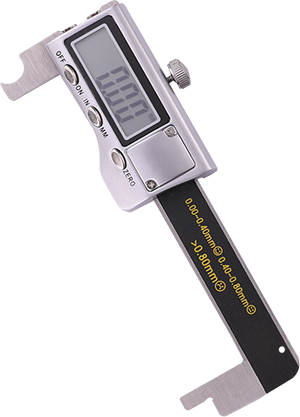
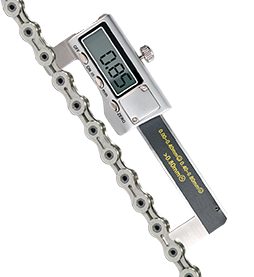
KMC has developed a special digital
chain wear indicator, the'Digital
Chain Checker'. This tool allows you
to exactly measure the chain's elongation,
changing the chain on time (not too
early and not too late) prevents excess
wear on other drive-train parts, so
you can prevent unnecessary high repair
costs.
There are also other effective mechanical
tools on the market which can help
you determine whether your chain needs
to be changed or not.
In general KMC recommends checks at
the following intervals: |
| -
road use and riding in the dry: every
500 kilometres?(300 miles); |
| -
off road use or more demanding environments:
every 150 kilometres (100 miles). |
Note:
The chain life varies; it depends
on the product you use, the circumstances
you ride under and the maintenance
you adopt.
- The easiest way to check
- The digital way to check
- Avoid extreme shifting positions!
- Correct chain length
Mount on smallest sprocket and
smallest ring: the chain should
to run as close as possible
to-. But just free of the derailleur
pulley
|
| |
 |
 |
| |
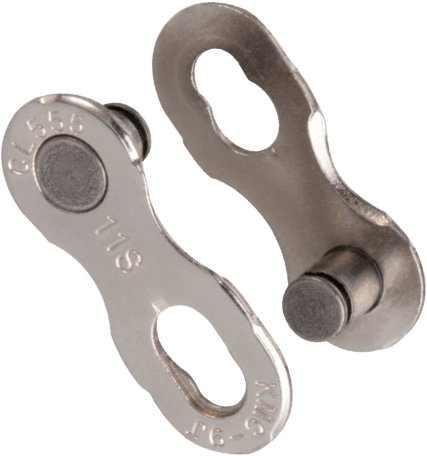
Connecting
Link Instructions |
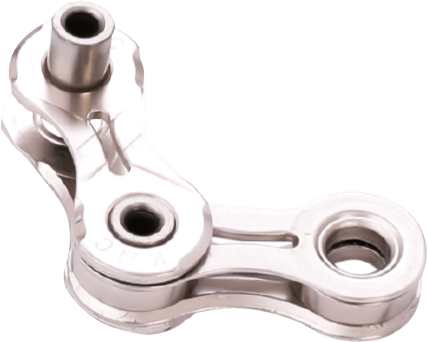
MissingLink
- Fit chain with the correct length,
clean bearing and lubricate
- Do not forget to lubricate the
pin
- Insert both halves of the MissingLink
into the chain ends
- Press both halves of the MissingLink
connector together
- Lock in place by pulling the
chain apart
- Opening: press both plates together
while sliding the chain ends towards
each other

|
 |
Snap-On
- Fit chain with the correct length,
clean and lubricate bearing and
pin
- Insert pin plates into both
chain ends
- Fit other plate over right pin
- Bend both ends of the chain
slightly towards you and click
in the other end
- Check connectors for correct
assembly. Opening: bend chain
slightly and pull off the plate

|
 |
|
Spring-Clip
- Fit chain with the correct length,
clean and lubricate bearing and
pin
- Insert pin plate into both chain
ends, then fit other plate over
both pins
- Place spring over both pins
(note: the closed side of the
spring must be in the forward
pedaling direction of the chain!)
- Use pliers to assemble spring

 |
 |